
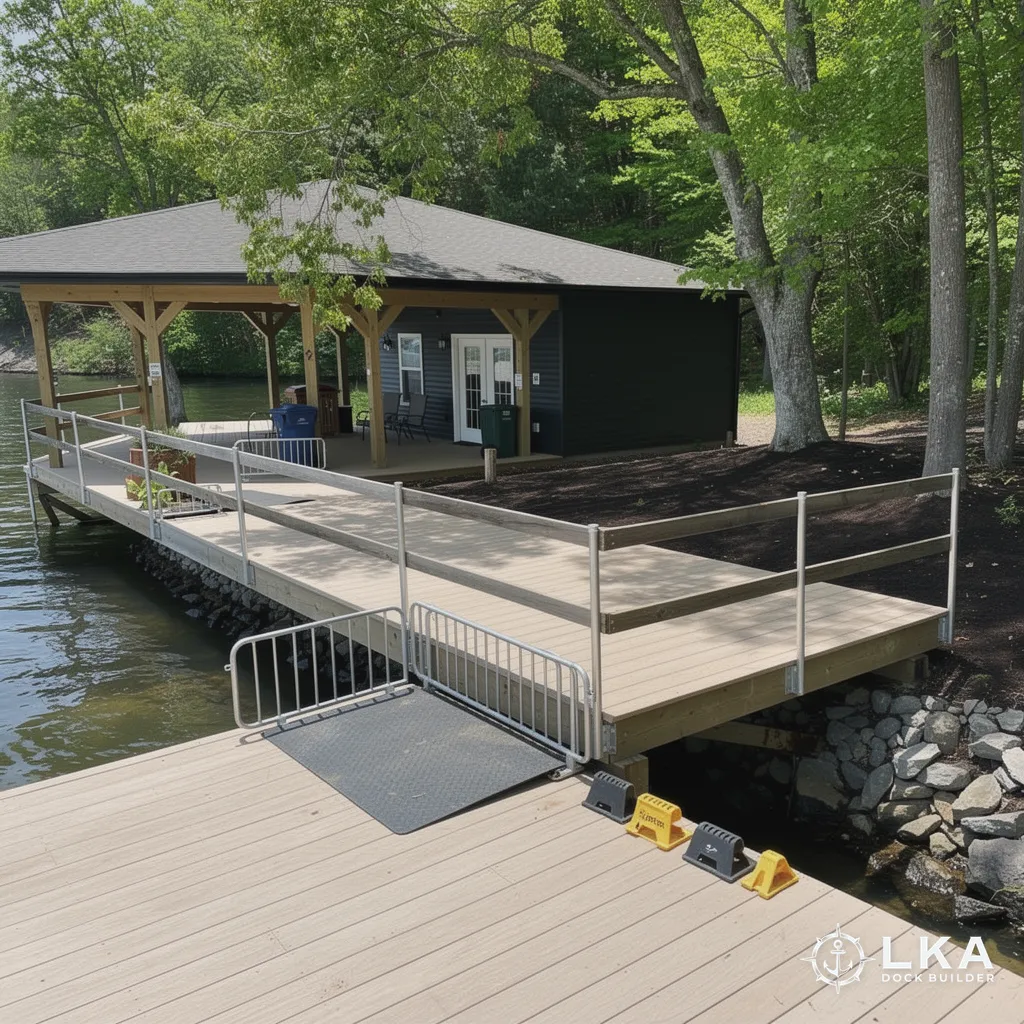
7 Occupational Safety and Health Administration Dock Safety Rules Virginia Builders Need to Know
OSHA (the Occupational Safety and Health Administration) mandates guardrails or dock edge protection, wheel chocks, proper lighting, and dock plates rated for load capacity. Standard 1910.28 requires fall protection for edges four feet or higher. LKA Dock Builder, based in Mineral, VA, designs loading docks that meet these OSHA loading dock requirements and the broader loading dock safety regulations governing dock construction today.
Loading dock compliance centers on OSHA 1910.26 for dockboards, requiring employers to ensure dockboards support the maximum intended load per 1910.22(b) and meet initial service requirements. Employers must also maintain safe distances from dock edges, use wheel chocks, paint dock edges for visibility, and prevent falls—hazards responsible for the majority of dock-related injuries.
Loading dock compliance requires OSHA-mandated fall protection, clear egress paths, and edge marking to prevent falls—one of the hazards forklift operators face per OSHA’s Powered Industrial Trucks eTool. Facility managers maintain safe distances from dock edges, keep surfaces clear of debris, address wet or icy conditions, and paint edges for visibility. These practices reduce incident risk across warehouse and logistics operations.
Key Takeaways
OSHA 1910.26 requires dockboards to meet specific structural and safety standards for loading dock operations.
Employers must maintain safe distances from dock edges to prevent workers from falling during forklift operations.
Loading dock surfaces need regular maintenance to prevent slipping hazards from wet or icy conditions.
Workers must slow down and remain aware of dock edges when operating powered industrial trucks like forklifts.
OSHA 1910.26 requires dockboards to meet specific structural and safety standards for loading dock operations.
Employers must maintain safe distances from dock edges to prevent workers from falling during forklift operations.
Loading dock surfaces need regular maintenance to prevent slipping hazards from wet or icy conditions.
Workers must slow down and remain aware of dock edges when operating powered industrial trucks like forklifts.
Why Do Loading Docks Carry Such High Risk?
Loading docks generate a disproportionate share of warehouse injuries. Roughly one in four warehouse-related injuries traces back to dock activity, a figure that puts dock safety near the top of any facility manager’s risk list. Trailers shifting away from levelers, forklifts operating near open edges, and uneven weight loads all combine at a single choke point in the supply chain.
That concentration of hazards is exactly why dock safety regulations for builders matter as much as day-to-day operational protocols. A structure must have proper load ratings, drainage, and edge protection to ensure safety when put into use.
What makes dock injuries so common compared to other warehouse areas?
Docks combine vehicle traffic, height changes, and constant material handling in a compact footprint. Few other zones in a facility force pedestrians, powered equipment, and delivery trucks to share space so tightly.
Does dock construction quality actually affect injury rates?
Structural integrity determines how well a dock handles daily stress from trucks, forklifts, and shifting loads. LKA Dock Builder brings marine construction experience that extends beyond residential waterfront projects to commercial structures where safety-focused building matters. cite-1 Based in Mineral, VA, the team applies regional, hands-on knowledge to every build:
Load-bearing design suited to equipment and vehicle traffic
Edge and drainage planning to reduce slip hazards
Materials selected for long-term structural reliability
Load-bearing design suited to equipment and vehicle traffic
Edge and drainage planning to reduce slip hazards
Materials selected for long-term structural reliability
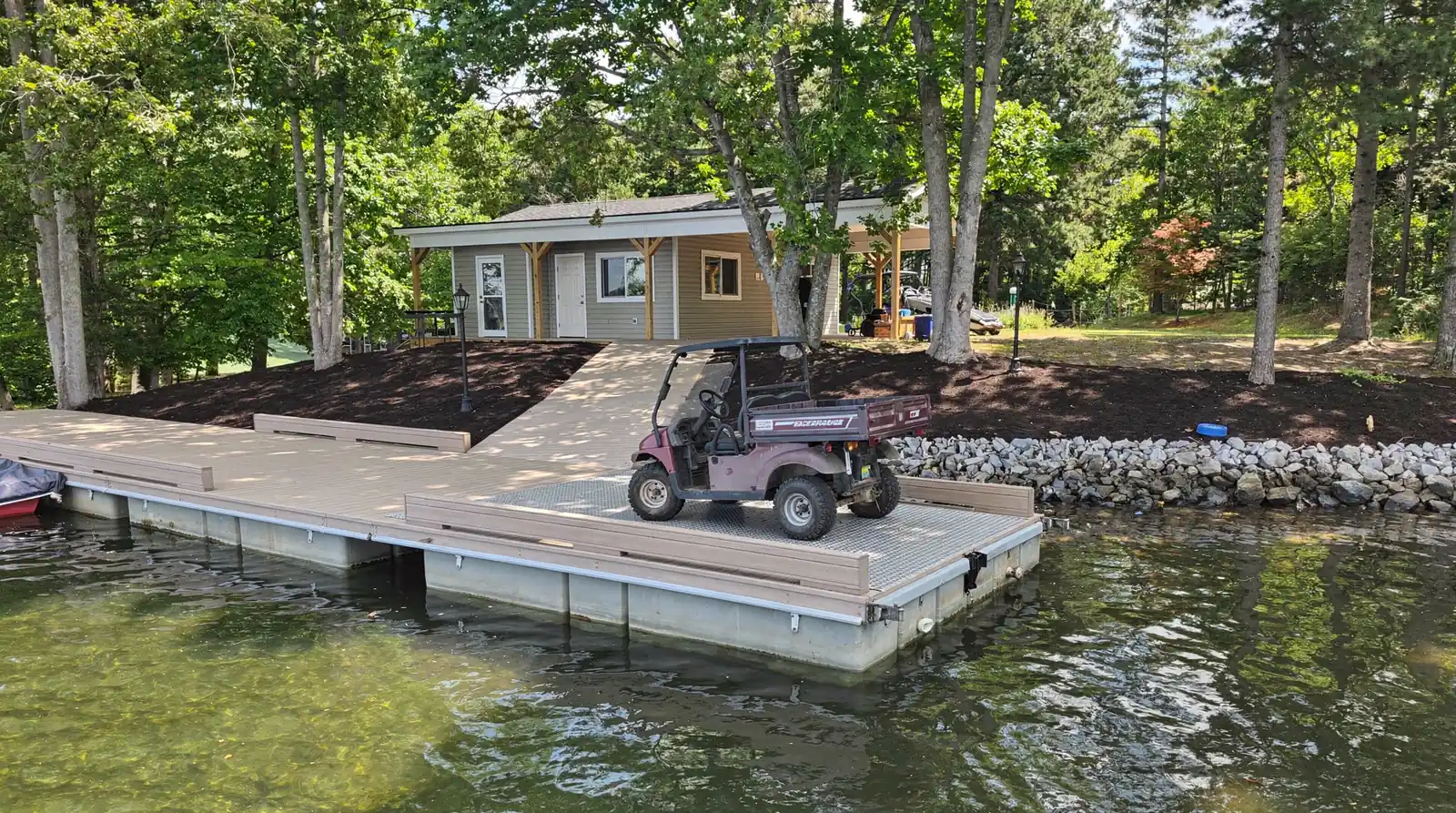
What Do OSHA’s Dockboard And Forklift Rules Require?
OSHA’s dockboard standard sets a hard limit on load capacity. Every dockboard installed at a facility must support the maximum intended load placed on it, per federal requirements. That single rule shapes how dock safety regulations for builders get applied on every project, from a small delivery ramp to a full loading platform.
Load capacity is only half the picture. Dockboards placed into service since January 17, 2017 must also be designed and maintained to keep transfer vehicles from running off the edge, which is why vehicle restraint systems belong in the same conversation as load ratings. Skip that detail, and a facility risks a forklift rolling off the platform mid-shift, a failure that costs far more than the price of proper construction.
Why Does Edge Protection Matter So Much For Forklift Traffic?
Forklifts moving across a dockboard need a stable, contained path. A board that shifts, flexes beyond its rated load, or lacks edge protection creates a fall hazard for the operator and the freight. Facility managers who verify both load rating and edge design close two compliance gaps at once.
Builders with years of hands-on marine construction experience bring that dual awareness into every design. Load-bearing structures get engineered to integrate with the working environment they serve, not just meet a paper minimum.
How Should Facility Teams Start A Compliant Dock Upgrade?
Consultation comes first. A qualified builder reviews the site, discusses material options, and produces a design before any construction begins. From there, the builder guides the permitting process and sets a realistic timeline, so compliance gets built in from day one rather than fixed after the fact.
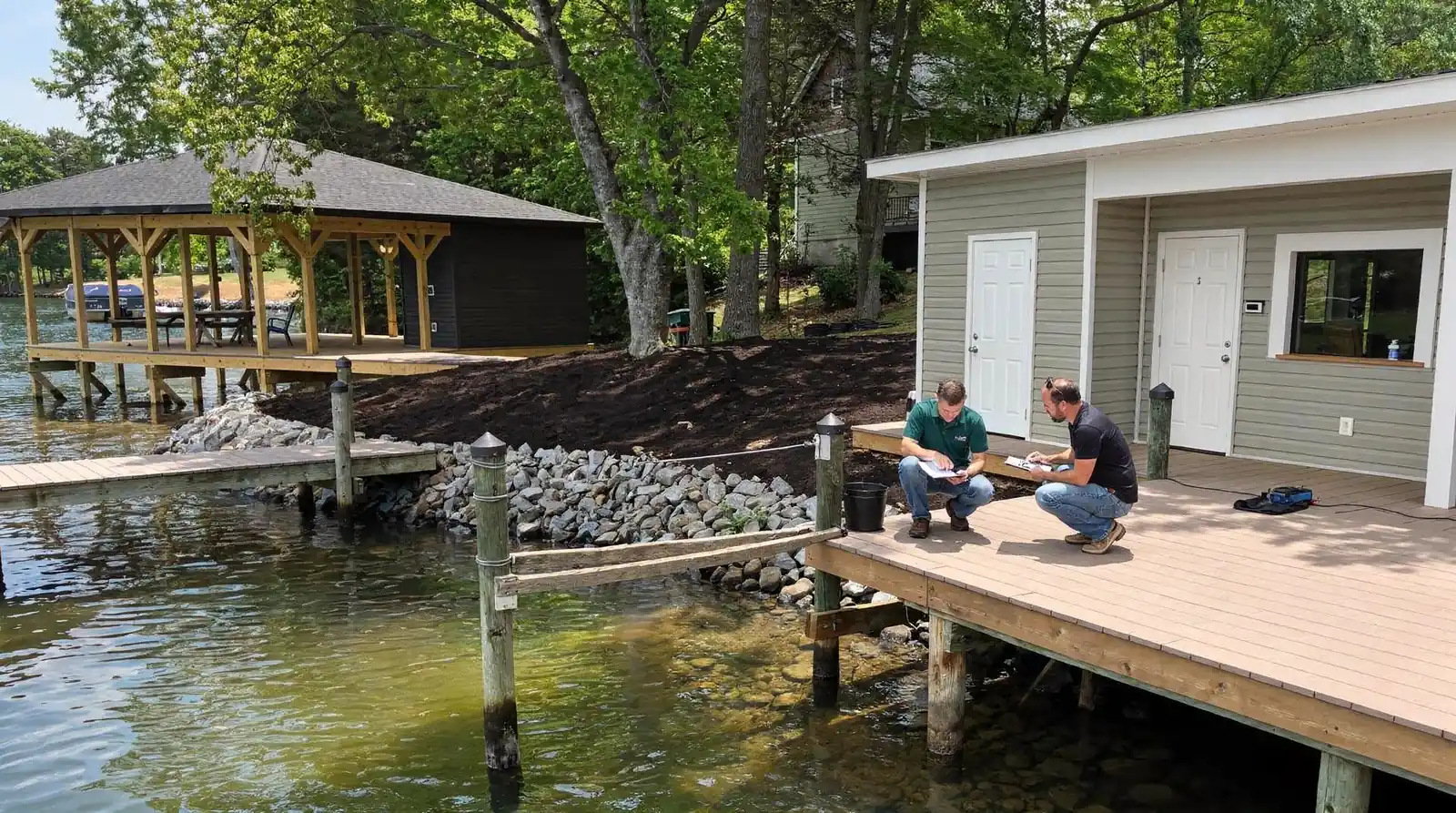
How Can Teams Sustain Long-Term Dock Compliance?
Long-term compliance depends on routine, not one-time fixes. Facility managers who schedule inspections at least twice a year, and again after major storms, catch cracked pilings, loose boards, and eroding shorelines before they become safety failures. Waterfront property owners, whether managing a single dock or a fleet of loading structures, need a builder with real experience to keep those structures sound year after year. cite-3 That’s where sustained dock safety regulations for builders compliance actually gets built: in the follow-up, not just the installation.
What keeps a dock compliant between inspections?
Ongoing maintenance protects the durability and effectiveness of marine structures over time. Skipping upkeep quietly erodes both safety margins and structural life.
A simple loading dock compliance checklist keeps these habits from slipping through the cracks. Practical steps operations leads can build into a compliance calendar:
Conduct full inspections twice yearly, adding checks after severe weather
Repaint dock edges regularly to keep them visible for forklift and cart operators
Track wear on pilings, boards, and elevator hardware between formal inspections
Partner with an experienced marine builder for repairs, not general contractors
Conduct full inspections twice yearly, adding checks after severe weather
Repaint dock edges regularly to keep them visible for forklift and cart operators
Track wear on pilings, boards, and elevator hardware between formal inspections
Partner with an experienced marine builder for repairs, not general contractors
Consistent habits like these turn compliance into a system, not a scramble.
Understanding and implementing OSHA loading dock safety standards protects the workforce and the operation’s long-term integrity. These regulations address critical hazards, from fall protection to equipment maintenance, that demand consistent attention and proper training. Facility managers who prioritize compliance build safer environments where employees work confidently and efficiently. Working with an experienced marine builder like LKA Dock Builder brings that same standard of quality and durability to every structure, turning safety infrastructure into a lasting investment rather than a one-time expense.
FAQ
What does OSHA 1910.26 require for dockboards?
OSHA 1910.26 requires dockboards to support the maximum intended load per 1910.22(b) and meet initial service requirements. Dockboards placed into service since January 17, 2017 must also keep transfer vehicles from running off the edge.
What practices reduce fall and slip hazards at loading docks?
Employers maintain safe distances from dock edges, use wheel chocks, paint edges for visibility, and keep surfaces clear of debris. Addressing wet or icy conditions further reduces slip hazards and incident risk.
Why do loading docks carry higher injury risk than other warehouse areas?
Trailers shifting away from levelers, forklifts near open edges, and uneven weight loads converge at this single choke point.
Ready to Close the Compliance Gaps in Your Loading Dock?
An out-of-spec dockboard, a missing vehicle restraint, or a worn piling isn’t just a paperwork problem — it’s the difference between a crew that goes home safe and an incident that shuts down operations, triggers fines, or costs far more to fix after the fact. Waiting for an inspection to find the failure is the expensive way to find out.
LKA Dock Builder designs and builds loading docks engineered to meet OSHA’s load, edge protection, and fall protection requirements from the first plank — backed by hands-on marine construction experience across commercial and waterfront structures. The result: a dock built for long-term durability and safety, not just a passing grade.
Contact LKA Dock Builder at +1-540-899-3625 or info@lkadockbuilder.com to schedule a site consultation and get a compliant, built-to-last dock underway.