
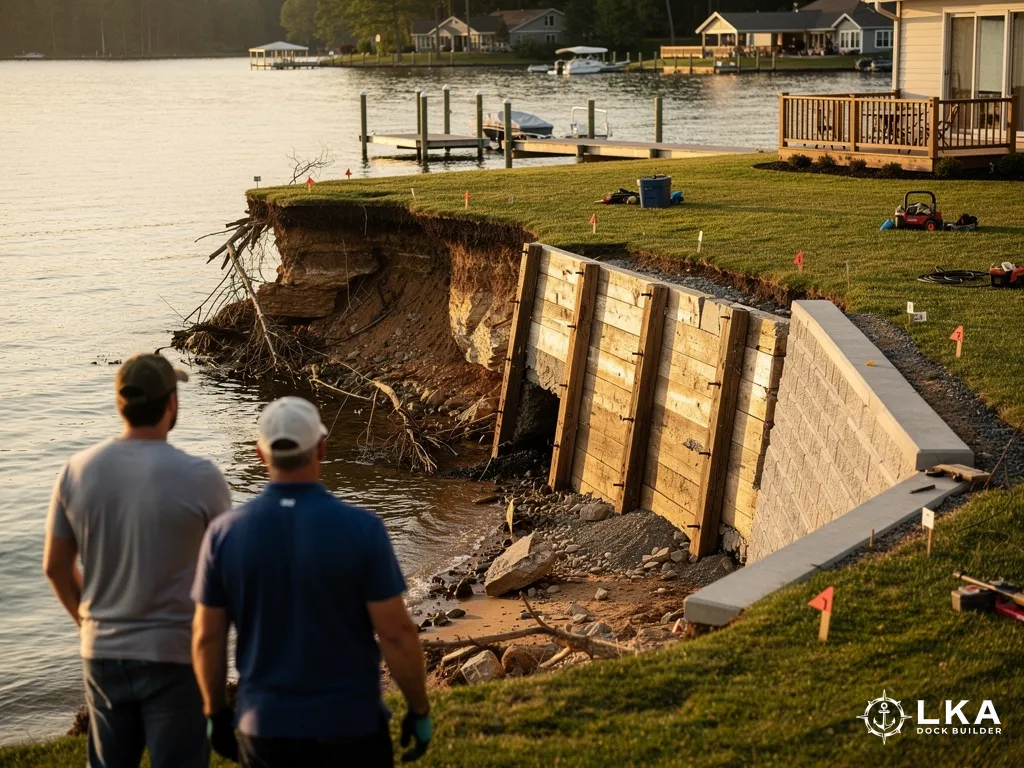
How Can Seawall Repair Affect My Property Value and Insurance Rates
A failing seawall erodes shoreline, shrinks usable land, and signals costly deferred maintenance to buyers, directly lowering Lake Anna property values. Waterfront property insurance for a seawall works the same way: carriers view structural instability as added risk, often raising premiums or denying coverage until repairs are completed. Lake Anna seawall repair restores protection, preserves equity, and keeps policies active.
Key Takeaways
A failing seawall directly reduces waterfront property value and complicates home sales.
Insurance carriers view structural instability as added risk, raising premiums or denying coverage.
Professional seawall repair restores protection, preserves equity, and keeps insurance policies active.
Delaying seawall repair compounds damage, increases eventual repair expenses, and diminishes property equity.
What Is a Seawall and Why Does It Matter?
A seawall is an essential feature for lakefront properties. The structure protects against erosion, preserves valuable land, and enhances property aesthetics. Lake Anna homeowners rely on these barriers to hold shorelines in place against constant wave action and fluctuating water levels.
The installation process begins with careful site preparation. A wood drive guide establishes the wall’s front alignment and elevation. The shoreline is evaluated for soil stability and environmental impact, ensuring the seawall design meets specific site requirements. This evaluation determines how the finished wall will perform over decades of exposure.
Steel, vinyl, or composite sheets are driven into the soil to form the primary structure. These sheets interlock to create a continuous barrier that resists lateral earth pressure and water intrusion. The material choice affects longevity, maintenance demands, and long-term property protection.
How Does a Seawall Protect Lakefront Property?
A seawall absorbs and redirects wave energy before it reaches the shoreline. Without this barrier, waves gradually eat away at the soil, shrinking usable yard space and threatening structures near the water. The wall also prevents soil from slumping into the lake during heavy rain or rapid water level changes.
What Happens When a Seawall Fails?
A failing seawall allows erosion to accelerate behind the structure. Cracks widen, soil washes out, and the wall begins to lean. Property owners then face a choice between seawall repair and natural barrier alternatives, each carrying different costs and longevity implications. Delaying action compounds the damage and increases eventual repair expenses.

How Does Seawall Failure Affect Property Value?
A failing seawall directly reduces waterfront property value. The damage complicates home sales and triggers expensive repair obligations that deter potential buyers. Duncan Seawall notes that a failed seawall decreases property value and makes selling the home a more complicated process. Repairing that failure also carries substantial financial strain.
The consequences extend beyond the structure itself. When a seawall fails, erosion follows. That erosion threatens the land the home sits on. For Lake Anna property owners, this means losing usable shoreline and facing property value depreciation that compounds over time. Buyers recognize the risk immediately. They see the leaning concrete, the cracks, the soil loss behind the wall. Those visible signs translate into lower offers or no offers at all.
What Are the Financial Risks of Ignoring Seawall Damage?
Ignoring early damage multiplies the eventual cost. Minor cracks and joint leaks worsen. The structure destabilizes. What begins as a manageable repair escalates into full replacement. Duncan Seawall emphasizes that repairing seawall failure can be very costly. That cost becomes a lien on the property’s marketability. Lenders often require a seawall inspection before approving waterfront mortgages. A failed inspection halts financing. The seller then faces two unappealing choices: fund the repair out of pocket or slash the asking price.
How Does Erosion From a Failed Seawall Impact Land Value?
Erosion eats away at the property’s most valuable asset: the land itself. A failed seawall leads to erosion with disastrous consequences for waterfront property owners, according to Duncan Seawall. Soil washes into the lake. The shoreline retreats. Trees and landscaping destabilize. The lot shrinks. For a Lake Anna homeowner, that lost land represents permanent value destruction. No cosmetic fix restores it. Monitoring for early seawall damage indicators like cracks, gaps, and soil loss helps prevent this outcome. Proactive maintenance preserves both the shoreline and the equity tied to it.
How Can Seawall Repair Affect My Property Value and Insurance Rates?
A deteriorating seawall directly threatens property value and insurance eligibility. How can seawall repair affect my property value and insurance rates? The answer hinges on structural integrity. A failing wall signals risk to lenders and insurers alike. Unaddressed damage often triggers coverage denial or steep premium increases. Property owners who delay repairs face diminished equity and fewer qualified buyers.
What Happens to Property Value When a Seawall Fails?
Seawall condition shapes buyer perception and appraisal outcomes. Seawall repair is best for minor damage like cracks, joint leaks, or isolated corrosion where the structure remains stable. These targeted fixes preserve the wall’s function without signaling systemic failure. A well-maintained seawall supports land retention and keeps the shoreline intact. That stability translates directly into sustained market value.
Replacement becomes necessary when there is significant leaning, widespread material failure, or loss of soil support behind the wall. Structural movement is the tipping point. At this stage, the property carries a known defect that appraisers and buyers discount heavily. The cost of full replacement, combined with the visible deterioration, often reduces offers well below market expectations.
How Do Insurers Evaluate Seawall Condition?
Insurance underwriters assess seawall integrity as part of overall property risk. Properties in flood zones face the most urgent inspection timelines and the greatest insurance pressure. A compromised seawall in these areas frequently leads to policy non-renewal or mandatory repair riders. Insurers view erosion control failure as a precursor to larger structural claims.
Staying ahead of deterioration with annual professional inspections is the single most cost-effective strategy waterfront owners can adopt. Documented maintenance records demonstrate proactive risk management. These records help property owners negotiate favorable terms and avoid last-minute coverage gaps. Without them, insurers assume deferred maintenance and price policies accordingly.
What Are the Costs of Repair vs. Replacement?
Seawall repair and replacement costs differ sharply, and the decision carries long-term financial consequences for Lake Anna property owners. Routine repairs typically run $25 to $125 per linear foot, according to Team Renick’s Sarasota-area maintenance data. Full replacement reaches $500 to $1,200 per linear foot depending on materials and site conditions. Choosing the wrong approach costs property owners far more than the initial estimate.
When Does Repair Make Financial Sense?
Repair works best for minor damage where the structure remains stable. Cracks, joint leaks, and isolated corrosion fall into this category. The lower per-foot cost makes repair attractive in the short term. However, incorrectly executed repairs lead to more significant issues down the line, ultimately costing the property owner more in the long run. A patch that fails within two years forces a second intervention, often at replacement-level pricing.
When Is Replacement the Only Viable Option?
Replacement becomes necessary when leaning, major cracking, or soil loss compromises the wall’s structural integrity. The higher cost reflects full excavation, new materials, and proper anchoring. Lake Anna property owners reviewing seawall installation costs should weigh replacement against repeated repair cycles. Bulkhead repair on lakefront property follows the same logic: shoreline stabilization cost estimates only hold up when the underlying structure is sound, so a wall with soil loss or active leaning rarely qualifies for a simple patch.
Approach
Cost Range per Linear Foot
Best For
Routine repair
$25–$125
Minor cracks, joint leaks, stable structure
Full replacement
$500–$1,200
Leaning walls, major cracking, soil loss
The gap between repair and replacement pricing is substantial. Yet a failed repair that accelerates erosion erases any initial savings. Property owners who defer replacement on a failing wall absorb higher costs later, including land loss and emergency stabilization. Seawall erosion damage also feeds directly into insurance scrutiny, since a wall priced beyond typical seawall replacement cost per linear foot ranges usually points to prior neglect that carriers factor into renewal terms.
How Do I Protect My Investment and Insurance?
Protecting a waterfront investment starts with proactive seawall maintenance and documented repairs. The answer hinges on structural integrity, inspection records, and the quality of materials used. A failing seawall erodes land, lowers appraised value, and triggers insurer scrutiny. A professionally repaired seawall preserves equity and keeps coverage stable.
LKA Dock Builder combines 3D design approval, shoreline regulation expertise, and premium materials like AZEK and Trex to deliver durable, lake-friendly docks, boathouses, and seawalls. This approach gives property owners clear documentation of structural soundness. Insurers and appraisers respond favorably to verifiable repair records.
What Documentation Do Insurers Want After a Seawall Repair?
Insurers typically request proof of professional installation, material specifications, and post-repair inspection notes. LKA Dock Builder provides 3D design approval before installation, creating a clear record of the planned work. Premium materials like AZEK and Trex signal long-term durability, which reduces perceived risk.
Does Workmanship Quality Affect Property Value?
Hands-on founders with 37 years of combined experience ensure precision workmanship, from laser-straight finishes to meticulous detailing. Buyers notice straight lines and clean joints. Poor workmanship invites renegotiation or lost offers. Quality construction protects resale value.
LKA Dock Builder is located in Mineral, VA, and serves Bumpass, Spotsylvania, and Orange counties. Lake Anna homeowners gain a local partner who understands shoreline regulations and lake-specific erosion patterns.
FAQ
How does a failing seawall reduce my property value?
A failing seawall erodes shoreline, shrinks usable land, and signals costly deferred maintenance to buyers. This directly lowers Lake Anna property values and complicates home sales.
Will my insurance rates increase if my seawall is damaged?
Insurance carriers view structural instability as added risk. They often raise premiums or deny coverage until professional seawall repair is completed.
What happens if I delay seawall repair?
Delaying repair compounds damage, increases eventual repair expenses, and diminishes property equity. Erosion accelerates behind the structure, threatening the land the home sits on.
Conclusion
A seawall repair that restores structural integrity preserves property value and keeps insurance coverage stable, while a failing wall erodes both. Property owners who invest in professional repairs and maintain clear documentation protect their equity and avoid premium increases. The decision to repair proactively, rather than defer, determines whether the shoreline asset supports or undermines the property’s long-term financial standing.